
The NFL's First Regular-Season Game in Australia Is This Week. Bringing a Dog There Takes Nine Months and One Scan That Can Undo All of It.
The 49ers and Rams open the season at the MCG — in the same city as Australia's only pet quarantine facility. The rules for getting a dog or cat there run about nine months, and every single step is keyed to one number.
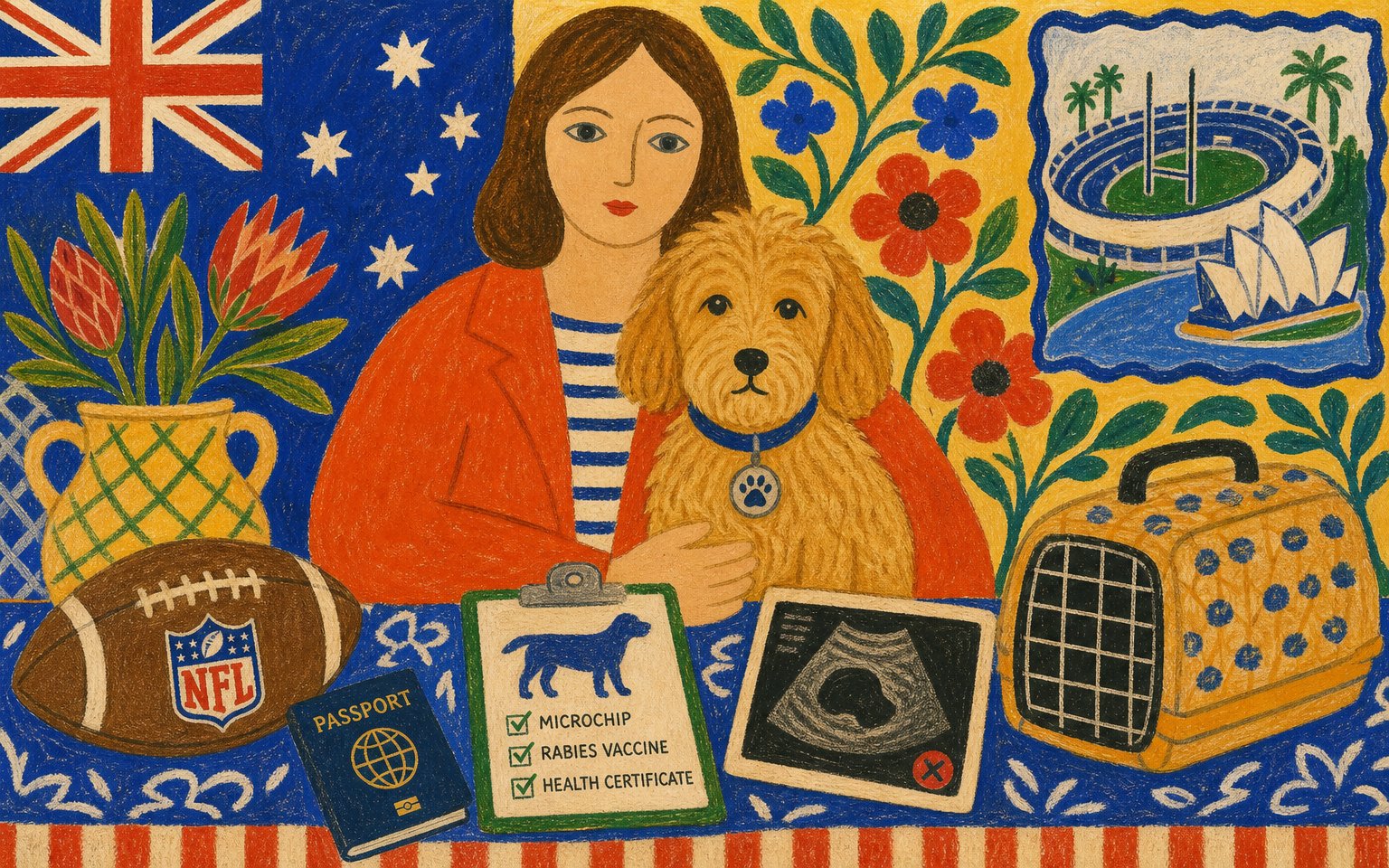
The San Francisco 49ers and Los Angeles Rams open the NFL season at the Melbourne Cricket Ground this week — the league's first regular-season game ever played in Australia, streaming on Netflix [1][2]. Kickoff lands Thursday night on the US East Coast, which is Friday morning in Melbourne.
Melbourne is also where every dog and cat that enters Australia spends its first days in the country. There is exactly one post-entry quarantine facility for pets in the whole of Australia, and it sits at Mickleham, on the northern edge of the city [3].
Australia's import rules are the strictest most American pet owners will ever deal with, and the timeline is what catches people out. The Department of Agriculture, Fisheries and Forestry tells owners to allow at least six months for health checks, tests and paperwork [4]. Seven to nine months is more realistic, because the steps have to happen in a particular order and one of them starts a 180-day clock that cannot be shortened.
Here is what that actually involves — and the small detail that quietly decides whether the rest of it holds together.
The microchip is the spine of the whole process
Every test, declaration and lab report in an Australian import file is tied to a single number: the one on the chip under your pet's skin. A veterinarian has to scan that chip and record the number at every visit — the rabies vaccination, the identity check, the blood draw, the parasite treatments, the final health certificate [5].
Which means a chip that has migrated, failed, or been transcribed with one wrong digit doesn't cause a delay. It undoes work. The department's wording is unusually blunt:
"If at any veterinary visit your animal's microchip cannot be read or if the unique number is incorrectly recorded on the animal's import documentation, then the animal cannot be imported to Australia... In some cases, the entire import process will need to be restarted." [5]
There is no paperwork fix, either. You cannot amend a lab report to correct a chip number — a wrong number on a rabies titre report means a fresh blood sample and a new test, drawn after the chip has been rescanned and verified [6]. The department issued that notice in 2022 specifically because it was seeing an increase in chip numbers being recorded incorrectly on permit applications and lab reports [6].
At the airport it gets sharper. If the chip cannot be read on arrival, or the number does not match the documentation, the animal is held in extended quarantine, and in rare cases the department can direct that it be exported or euthanased [5].
The chip itself has to clear three bars:
- It must be ISO compliant — generally a 10- or 15-digit number [4].
- It must be readable by an Avid, Trovan, Destron or other ISO-compatible reader [5].
- Numbers beginning with 999 are not accepted, because they are not unique [4].
If your pet was chipped years ago, or you adopted them and inherited someone else's chip, this is worth confirming in month one rather than month seven. Ask for a scan, check that the number reads cleanly, and check that the number your registry holds matches the number on the scanner. A mismatch found early costs a phone call.
The 180-day clock, and what actually starts it
The United States sits in Australia's Group 3 — approved countries where rabies is present but well controlled [7]. Guam and Hawaii are handled separately as Group 2, a materially shorter path, so a reader in Honolulu is not in the same process as a reader in Ohio [7].
Group 3 means a rabies neutralising antibody titre test, or RNATT. The sample has to return at least 0.5 IU/ml; below that, the animal is revaccinated and retested [4].
Then the wait. Your pet cannot be exported to Australia for at least 180 days after the sample arrives at the laboratory — not the day it was drawn — and the department states there are no exceptions [4]. The reasoning is straightforward: a dog or cat can be infected with rabies and show no signs for up to 180 days [8].
The test then stays valid for 365 days from the sampling date [8]. So you get a six-month wait followed by a six-month window to fly, and for a Group 3 animal the import permit expires when the titre does [9].
The decision that costs twenty extra days
Quarantine at Mickleham is a minimum of 30 days by default. It drops to 10 days only if an official government veterinarian verified your pet's identity before the RNATT blood sample was taken — and the department is explicit that the identity check cannot happen at the same appointment as the blood draw [4].
A vaccination card or a pet passport will not satisfy it. For US owners the instrument is the Part 3 USDA Identity Declaration, endorsed through the USDA's VEHCS system [10].
So the choice that saves you twenty days of quarantine and roughly a thousand Australian dollars has to be made months before you fly, at an appointment you would not otherwise have booked. It may be the easiest saving in the whole process to miss.
Current Mickleham fees, per animal [11]:
| Item | AUD |
|---|---|
| Reservation | $269 |
| Importation | $1,078 |
| Accommodation, 10 days | $530 |
| Accommodation, 30 days | $1,590 |
| Overstay | $53 per day |
That comes to roughly $1,877 for a 10-day stay and $2,937 for 30 — before the permit, the vet visits, the crate or the flight. The import permit adds AUD $603 for the first cat or dog and $288 for each additional animal in the same consignment, and it is non-refundable the moment you submit [9]. Processing usually runs 20 to 40 business days, though the department warns it can take up to 123 [9].
Two things a lot of US guidance still gets wrong
Ehrlichia canis testing is no longer required. The department removed it for all dogs effective 1 November 2022 [12]. A good number of American pet-relocation guides still list it.
Quarantine is not a flat 10 days. It is 30, unless you earned the reduction with the pre-RNATT identity check above [4].
Both are reasons to work from the department's current pages rather than a guide of unknown vintage. The rules move: as recently as 2 March 2026, non-desexed dogs being tested for Brucella canis also have to not have been mated or inseminated from at least 21 days before the sample is collected [13].
The rest of the pre-export list
For dogs travelling from the US, alongside the rabies work [4]:
- Internal parasites — two treatments within 45 days before export, at least 14 days apart, the second within 5 days of the export date.
- External parasites — beginning at least 30 days before export, repeated per the manufacturer's directions.
- Leptospira interrogans serovar Canicola — either a primary vaccination course finishing between 12 months and 14 days before export, or a negative test within 45 days of export.
- Brucella canis — a negative RSAT, TAT or IFAT on a sample collected within 45 days before export, for dogs that are not desexed.
- Leishmania infantum — a negative IFAT or ELISA within 45 days of export.
Cats have their own list and the same 30-day-or-10-day quarantine structure [14].
If you were only going for the football
None of this applies to a two-week trip, because a two-week trip to Australia with your dog is not really on the menu. There is no short-stay exemption, no shortcut past the titre wait, and the quarantine stay is not optional. Australia is somewhere you move a pet to, not somewhere you take one.
Which is useful in its own way. If the game has you thinking about a longer stint in Melbourne, the first thing to do is also the cheapest: get the chip scanned, and make sure the number on the scanner is the number everyone else has on file.
Sources
- Netflix Tudum, NFL in Melbourne 2026: How to Watch. https://www.netflix.com/tudum/features/nfl-melbourne-game-2026-how-to-watch
- Los Angeles Rams, First look: Rams take on 49ers in Australia to kick off 2026 season. https://www.therams.com/news/first-look-rams-take-on-49ers-in-australia-to-kick-off-2026-season
- Australian Department of Agriculture, Fisheries and Forestry, Quarantine facilities and fees. https://www.agriculture.gov.au/cats-dogs/quarantine-facilities-and-fees
- DAFF, Group 3 step-by-step guide for dogs. https://www.agriculture.gov.au/biosecurity-trade/cats-dogs/how-to-import/step-by-step-guides/category-3-step-by-step-guide-for-dogs
- DAFF, Microchips. https://www.agriculture.gov.au/biosecurity-trade/cats-dogs/microchips
- DAFF, Industry advice notice 111-2022: Correct recording of microchip numbers. https://www.agriculture.gov.au/biosecurity-trade/import/industry-advice/2022/111-2022
- DAFF, Step-by-step guides — country groups. https://www.agriculture.gov.au/biosecurity-trade/cats-dogs/how-to-import/step-by-step-guides
- DAFF, Rabies neutralising antibody titre test. https://www.agriculture.gov.au/biosecurity-trade/cats-dogs/rabies-neutralising-antibody
- DAFF, Import permit. https://www.agriculture.gov.au/biosecurity-trade/cats-dogs/how-to-import/permit
- USDA APHIS, Pet travel from the United States to Australia. https://www.aphis.usda.gov/pet-travel/by-country/australia
- DAFF, Quarantine fees. https://www.agriculture.gov.au/biosecurity-trade/cats-dogs/quarantine-facilities-and-fees/fees
- DAFF, Industry advice notice 203-2022: Removal of Ehrlichia canis testing. https://www.agriculture.gov.au/biosecurity-trade/import/industry-advice/2022/203-2022
- DAFF, Industry advice notice 37-2026: Brucella canis import conditions. https://www.agriculture.gov.au/biosecurity-trade/import/industry-advice/2026/37-2026
- DAFF, Group 3 step-by-step guide for cats. https://www.agriculture.gov.au/biosecurity-trade/cats-dogs/how-to-import/step-by-step-guides/category-3-step-by-step-guide-for-cats