
It's Child Passenger Safety Week. There's No Federal Standard for the Thing Holding Your Dog, So the Testers Borrowed the One for Car Seats.
Child Passenger Safety Week runs September 20–26. There is no federal crash standard for pet restraints, so the Center for Pet Safety applied the child seat one — and in its harness study, one product out of twelve passed.
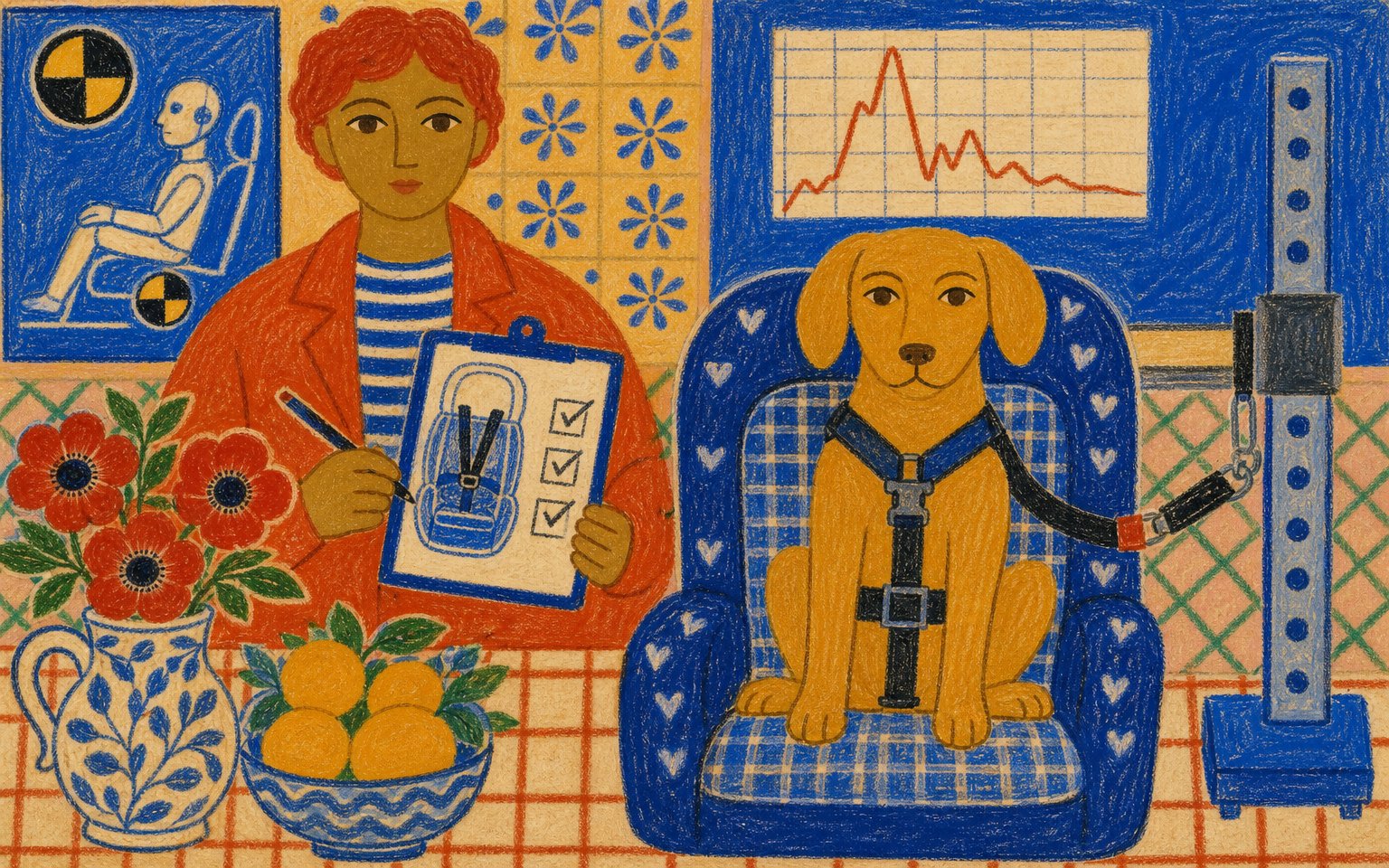
National Child Passenger Safety Week runs September 20–26 this year, and the message is the familiar one: the right seat, installed the right way, checked by someone who does this for a living. [1]
There is no equivalent week for the other passenger in the back. There is also no federal standard for pet restraints — no FMVSS number of their own, no required testing, no agency checking the claim printed on the box. So when the Center for Pet Safety went looking for a benchmark, it borrowed the children's one. The CPS harness protocol applies the head excursion limits from FMVSS 213, the federal standard for child restraint systems. [2]
That borrowing is the reason this week is a reasonable time to look at what your dog is riding in.
Of twelve harnesses, one passed
CPS ran its harness study in 2013. Twelve products were evaluated; four failed preliminary testing outright, eight qualified for crash testing, and one met all the requirements — the Sleepypod Clickit Utility, named that year's top performer. [2]
The failures were not subtle. Products allowed the test dog to launch off the seat and risk a secondary impact. Hardware deformed. Stitching gave way. Head excursion went past the limit. Several results met the study's definition of catastrophic failure. In a follow-up the next year, CPS concluded that apart from the one passing harness, the products tested were "insufficient in design, materials and overall performance." [2]
CPS ran crates and carriers in 2015, with Subaru. Three products came out as top performers: the Gunner Kennels G1 Intermediate with 8-foot tie-down straps in the crate category, and the PetEgo Forma Frame Jet Set Carrier with ISOFIX-Latch connection and the Sleepypod Mobile Pet Bed with PPRS Handilock in the carrier category. [3]
Worth knowing before you shop: the products CPS pulled in for that round were ones already claiming to be "tested," "crash tested," or to offer "crash protection." [3] Those phrases are marketing copy rather than certification. A restraint that names the standard it was tested against, and who ran the test, is telling you something the phrase on its own does not.
The arithmetic behind the seat belt
AAA and Kurgo put numbers on what an unrestrained dog becomes in a collision. A 10-pound dog at 50 mph generates roughly 500 pounds of force. An 80-pound dog at 30 mph generates roughly 2,400 pounds. [4]
That force lands on whoever is in front of the dog, and the dog absorbs the other half of it.
The distraction comes first
Before any of that, there is the ordinary drive. In a 2010 AAA/Kurgo survey of 1,000 dog owners who had driven with their dog in the previous year, 21% had let the dog sit in their lap while driving, 55% had petted the dog behind the wheel, 7% had handed over food or water, and 5% had played with the dog. Thirty-one percent admitted to being distracted by their dog; 59% had done at least one of those things. Only 17% used any form of restraint. [5]
A later study looked at the consequences in one group specifically. Researchers followed 2,000 licensed drivers aged 70 and older, 691 of whom owned pets and 58% of whom drove with them. Drivers who said they always had a pet in the car had a collision rate of 9.65 per million person-miles, against 5.1 for drivers with no pet in the car — about 1.89 times higher. Drivers who did it only sometimes or rarely showed no elevated rate at all. [6]
The authors were careful about what they could not say. The survey never asked whether the pets were restrained, which they noted could affect the potential for distraction. [6] So the study points at a pattern rather than a cause. Still, the group at risk was the group for whom the dog in the car is simply routine.
What to check this week
- Look for the standard, not the adjective. CPS publishes its certified list. A product that names its test protocol is making a checkable claim; "crash tested" on its own is not. [3]
- Back seat, behind the front seats. In the AAA/Kurgo survey, 54% of dogs rode in the back seat, 26% in the front, 17% in the cargo area and 2% in a pick-up bed. [5] A front-seat airbag deploys at a height and speed built for an adult human.
- Match the restraint to the actual dog. Harnesses are rated by weight range, and the rating is the part doing the work. A harness sized generously may not perform the way its testing suggests.
- Anchor the crate. The crate that passed CPS testing passed with its tie-down straps. An unanchored crate is cargo.
- The lap is the easiest habit to drop. One in five drivers in that survey had a dog in their lap. It is also the position that puts the dog directly in the airbag's path.
- Keep your contact details current wherever your pet's ID lives. After a collision, a frightened pet who gets out of the car tends to run, and the people at the scene are busy with the people. It is a small piece of housekeeping that costs nothing this week.
Most trips end the way they always do. The reason this week exists for children is that the exception is expensive, and the fix is a one-time purchase and a five-minute install. The same logic travels reasonably well to the back seat.
Sources
- National Highway Traffic Safety Administration / Traffic Safety Marketing, "Child Safety"
- Center for Pet Safety, "2013 Harness Study Results"
- Subaru of America and Center for Pet Safety, "Studies Showcase Promising and Shocking Crash Test Results of Pet Crates and Carriers", 2015
- Kurgo, "Dog Travel Statistics"
- AAA and Kurgo, "One in Five Respondents to AAA/Kurgo Survey Admit to Driving With Dog in Their Lap", August 2010
- "Driving with Pets as a Risk Factor for Motor Vehicle Collisions among Older Drivers", Accident Analysis and Prevention