
Hawaii Gets a Second Storm This Weekend. Most Pet Owners Don't Know If Their Shelter Takes Pets.
Tropical Storm Moke is bearing down on a Big Island that is still drying out from Hurricane Lala. Hawaii's county shelters take pets — but on the mainland that is not the default, and the federal pet law does less than its name suggests.
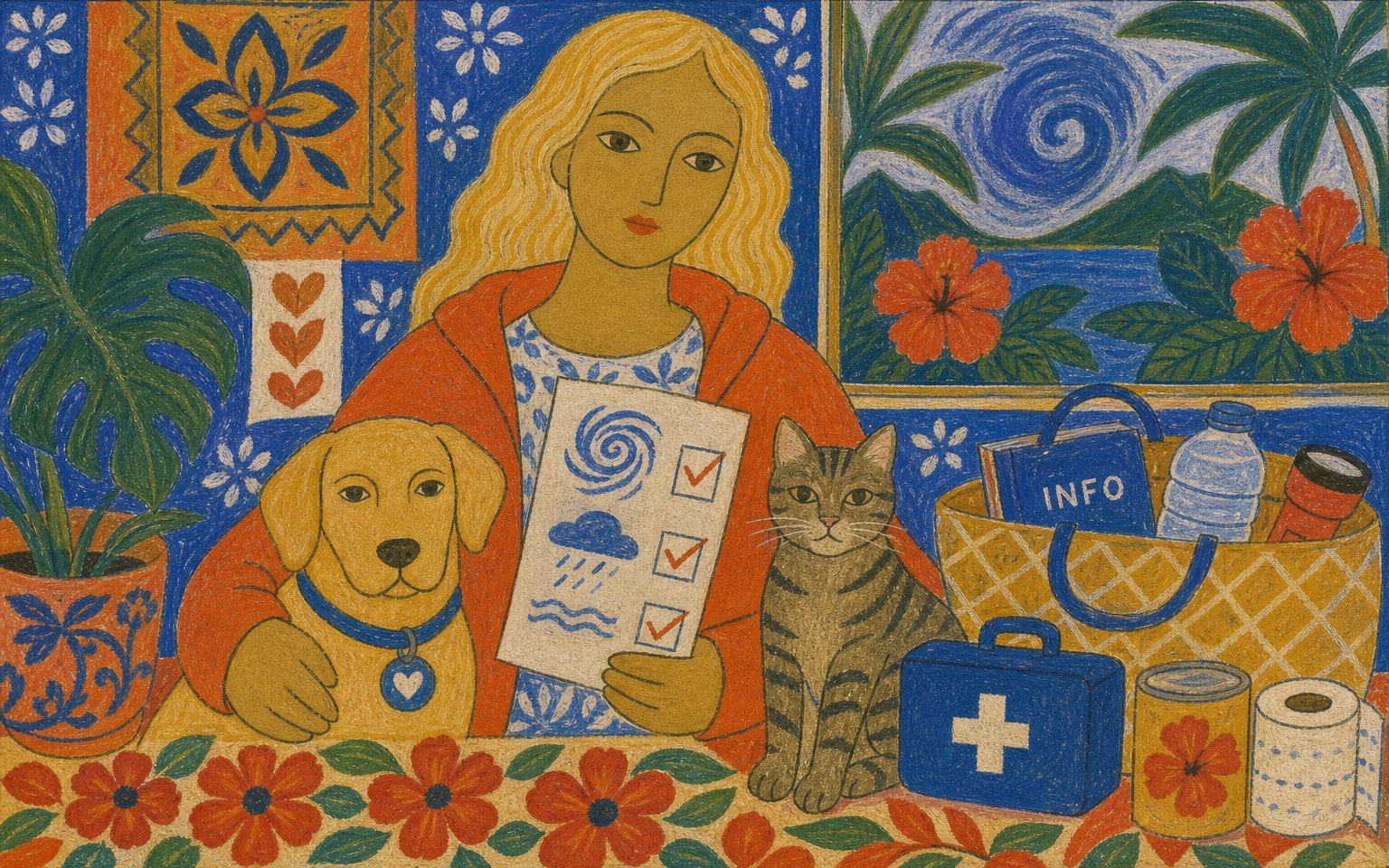
Tropical Storm Moke is closing on Hawaii for a Sunday pass south of the Big Island, and the National Weather Service has the island under a flood watch into Monday afternoon. The forecast is 5 to 10 inches of rain over windward and southeastern slopes, locally up to 15. Maui may see a few inches, the smaller islands one or two.
The number that matters more than the rain total is what fell last weekend. Hurricane Lala left Hawaiʻi County with more than 500 residential damage reports, and Hawaiian Electric was still restoring roughly 9,600 customers on Friday. Retired National Weather Service hydrologist Kevin Kodama put it plainly: the southeastern part of the Big Island "is very fragile right now," and saturated ground can turn ordinary rain into flash flooding faster than usual.
If you live there, the open question tonight probably isn't whether to prepare. It's where you would go, and whether the dog and the cat come with you.
The federal law is about planning, not admission
The PETS Act — the Pet Evacuation and Transportation Standards Act, signed in October 2006 after Katrina — gets cited constantly, and it is usually described as if it guarantees you a spot with your animals. It doesn't.
What it actually does is condition federal disaster funding on state and local emergency plans taking household pets and service animals into account. It is a planning requirement pointed at governments, not an admission requirement pointed at any particular shelter, and it creates no right you can personally enforce. It also covers a narrower set of animals than most people assume: domesticated dogs, cats, rabbits, rodents and turtles not kept commercially, plus service animals. Horses, livestock and most birds sit outside it. And the pet-friendly sheltering it enables generally follows a declared emergency, which can be well into an event.
So the honest national picture is the one the CDC states directly: many evacuation centers, including Red Cross centers, do not allow pets.
Hawaii is unusually good about this
Against that backdrop, the three Hawaii counties are a bright spot, and they said so out loud during Lala just last week.
- Oʻahu. The City and County of Honolulu's Department of Emergency Management says all shelter locations — assembly areas, hurricane refuge areas, evacuation shelters and post-impact shelters — are pet friendly. Pets must be secure on a leash or in a carrier, and owners bring their own supplies.
- Hawaiʻi County. During Lala, the county's guidance was blunt and specific: shelters are pet friendly, and pets must be kept in a carrier.
- Maui County. Pets are allowed at most shelters and must be crated, in a carrier large enough to stand, turn around and lie down. Maui Humane Society adds that pets should be current on vaccinations.
That word "most" in the Maui guidance is the reason to look up your own county's list tonight rather than assume.
The gap is usually knowledge, not policy
A nationally representative survey of 1,000 U.S. pet owners fielded by PetSmart Charities in 2023 found:
- 76% said they would stay home with their pets if an evacuation order meant leaving the animals behind.
- 80% said they would give up a shelter spot if their animals couldn't stay with them.
- 63% were unsure whether pet-friendly sheltering was even available near them.
That last figure is the actionable one. It is also the older story: a widely cited Fritz Institute survey after Katrina found that roughly 44% of people who stayed put did so at least partly because of their animals. Twenty years on, the policies have improved considerably and the awareness has not kept pace.
The twenty-minute version of a plan
If a storm is anywhere in your forecast, this is the short list.
- Find your county's shelter page and read the pet line. Not the state page, not the federal one. Counties run shelters, and they publish the crate rules.
- Have a carrier per animal, and let them see it before the emergency. A cat who has never been in a carrier does not become one in a hurry, and "crated" is the condition attached to nearly every pet-friendly shelter.
- Pack food and water for two weeks in sealed containers, per Hawaiian Humane Society's guidance, plus medications, bowls, litter and cleanup supplies, bedding and one familiar toy.
- Bring paperwork. Vaccination records, your vet's information, and a photo of your pet with you in the frame — the AVMA recommends that specifically, because it doubles as proof of ownership if you and your animal get separated and reunited through a shelter.
- Check the tag and the chip registration. A collar tag is what a neighbor reads; a microchip is what a shelter scans. Hawaiian Humane's phrasing is hard to improve on: make sure the chip is updated with your current contact information "before the weather report spells trouble."
- Put a rescue alert sticker on the door listing how many animals live there and your vet's number, and if you have time on your way out, write EVACUATED across it.
Why the chip line matters more than it sounds: in an Ohio State study of 7,704 microchipped animals across 53 shelters, owners were located for 72.7% of them — and the single largest reason for the failures was an incorrect or disconnected phone number, at 35.4%. A more recent analysis of 17 government shelters found microchipped pets were over three times as likely to be reunited, but only 18% of stray arrivals had a chip at all.
If you're nowhere near Hawaii
The Atlantic is quiet this week, which is exactly the useful moment. The climatological peak of the season is September 10. The county lookup, the carrier, and the two minutes it takes to confirm your registry has a phone number that still rings are all easier to do now than on the day a watch goes up.
And the line every humane society repeats is the right one to end on: if it isn't safe for you, it isn't safe for them.
Sources
- Tropical Storm Moke continues toward Hawaii — Hawaii Tribune-Herald, Aug 22, 2026
- Hawaii tropical storm Moke forecast — weather.com, Aug 22, 2026
- Central Pacific Hurricane Center advisories — NOAA
- Shelter information — City and County of Honolulu, Department of Emergency Management
- Hurricane Lala shelter update — Hawaiʻi County, Aug 15, 2026
- Emergency shelter FAQ — Maui County
- Disaster Ready — Hawaiian Humane Society
- Pet Disaster Preparedness — Maui Humane Society
- Pets in evacuation centers — CDC
- A Look at the PETS Act and Related Florida Law in the Wake of Hurricane Ian — The Florida Bar Journal, 2023
- PETS Act FAQ — AVMA
- Pets and disasters — AVMA
- Disaster preparedness — ASPCA
- Majority of pet parents say they wouldn't evacuate without their pets — PetSmart Charities survey, 2023
- Hurricane Katrina animal rescue facts — Louisiana SPCA
- Microchips result in higher rate of return of shelter animals to owners — Ohio State University
- Pets with microchips are three times more likely to get home — Human Animal Support Services