
Americans Will Spend About $1 Billion on Pet Costumes This Week. Of 135 Cats Who Bit Into Glow Jewelry, Nearly Half Briefly Lost Their Minds — and All of Them Recovered.
The National Retail Federation puts 2026 Halloween spending at $13.5 billion, with roughly $1 billion of it on pet costumes. The accessory most likely to produce a 2 a.m. panic is the glow stick clipped to the collar — and the poison-control data on it is reassuring in a way the drooling is not.
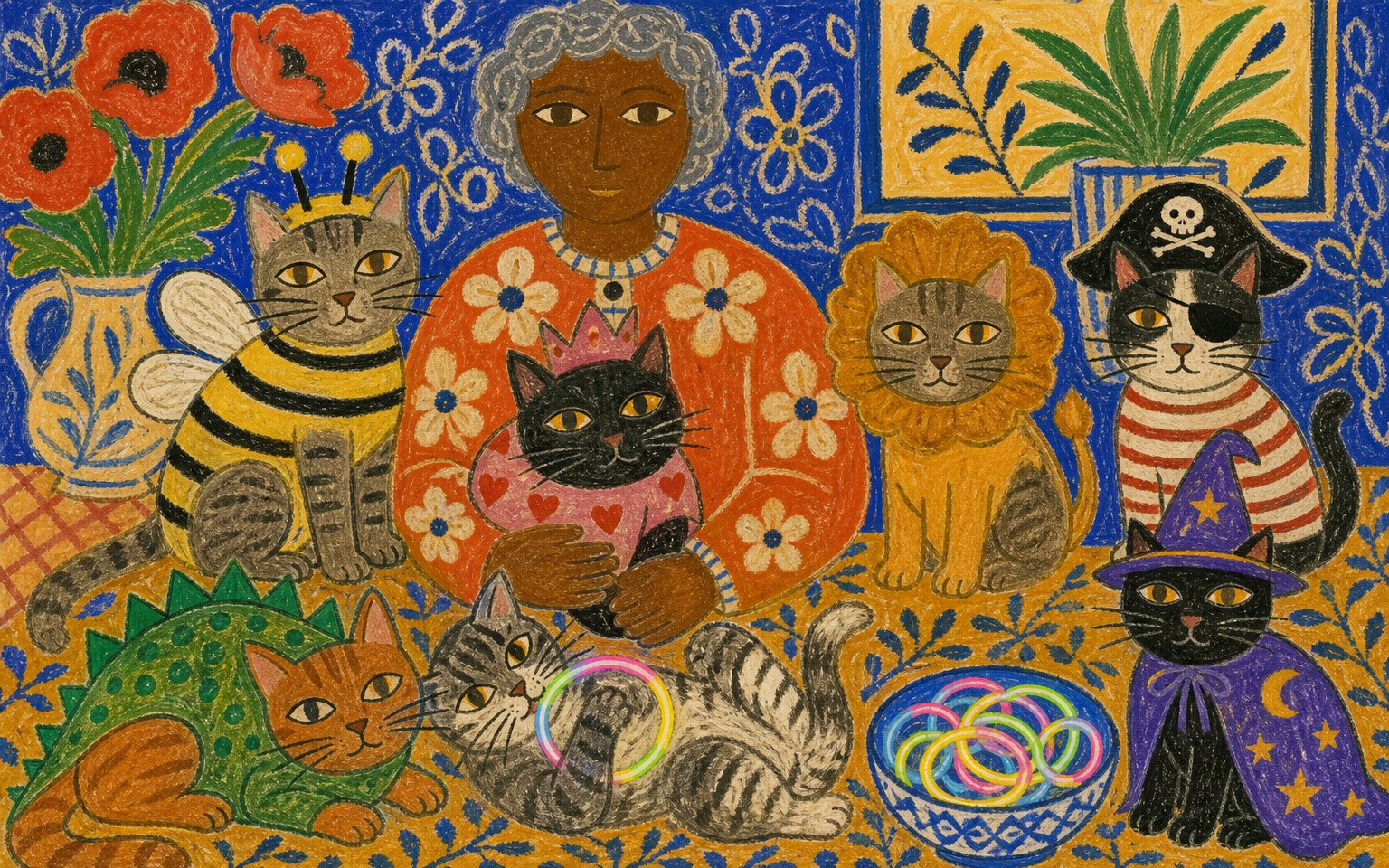
The National Retail Federation expects Americans to spend $13.5 billion on Halloween in 2026, up from a record $13.1 billion last year, based on a survey of 7,889 consumers run September 1–9. [1][2] Of that, roughly $1 billion goes to pet costumes alone — up from $860 million in 2025 and about $700 million in 2024. [3] Twenty-three percent of consumers plan to put their pet in a costume, up from 17% in 2019. [4]
The costume itself is rarely the thing that generates a late-night phone call. The glow stick clipped to it is.
What happens when a cat bites a glow stick
Glow jewelry is filled with dibutyl phthalate, or DBP. A standard necklace holds about 3 ml of liquid, most of it DBP. [5]
The ASPCA Animal Poison Control Center consulted on more than 135 cases of cats biting into glow-in-the-dark jewelry and wrote up the pattern. Almost every affected cat showed a sudden onset of heavy drooling. Close to half showed neurologic signs — mostly hyperactivity and aggression, the cat tearing around the house as though something is wrong with it. [5]
To an owner at 9 p.m. on October 31, that looks like poisoning. The toxicology says otherwise. DBP's oral LD50 in rats is above 8 g/kg, which puts it in the low-order acute toxicity bracket. For a 4 kg cat, swallowing an entire necklace would still be under one-tenth of that figure — and owners generally reported that most of the liquid stayed in the necklace rather than going down the cat. [5]
Recovery is complete, usually within minutes, with or without treatment. The APCC has had no long-term effects and no deaths reported to it from these cases. [5] The signs look like a neurologic emergency, but they read better as a very strong reaction to a very bad taste.
Pet Poison Helpline reaches the same conclusion from a different angle: it ranks glow sticks and glow jewelry in its lower danger tier for Halloween, alongside candy corn and gummies — and notes that most of its glow-stick calls involve cats, not dogs. [6]
What to do if it happens
The ASPCA's write-up is straightforward. [5]
- Offer something tasty. A small amount of milk, canned food, or tuna juice dilutes the taste, which is what is driving the behavior.
- Wash the coat. Soap and water on any skin or fur that got liquid on it. Otherwise the cat grooms, re-tastes it, and the whole scene starts again.
- Flush the eyes with plenty of water if any got in them.
- Call your vet or a poison-control line if a lot was swallowed. There is no antidote; large ingestions get monitoring and supportive care.
The things on the ranked list above it
Pet Poison Helpline sorts the Halloween hazards by how much danger they carry, and the top tier is worth reading before the bowl goes by the door. [6]
Highest concern: dark chocolate and baking chocolate, xylitol-sweetened candy and gum, raisins, and THC edibles.
Moderate: milk chocolate bars — plus the wrappers and lollipop sticks, which can cause a bowel obstruction that costs more to fix than the chocolate ever would have.
Lower: candy corn, Starburst, gummies, Skittles, glow sticks and glow jewelry.
Chocolate has been the single most common call to the helpline for more than a decade, and about 95% of those calls are about dogs. [6] The split between species is close to the inverse of the glow-stick split, which is a decent summary of the evening: the dog is in the candy bowl, the cat is chewing the thing that lights up.
Ten minutes before the doorbell starts
A few checks that take less time than putting the costume on:
- Try the costume on now, not at 5 p.m. Watch for anything that tightens around the neck or chest, anything with a dangling piece small enough to swallow, and whether your pet can still blink, pant and walk normally. A pet freezing in place or trying to back out of the outfit is telling you something.
- Put the candy somewhere with a door on it. Counters may not be enough; a bag on a chair certainly isn't.
- Give the dog a reason to be somewhere else. Forty doorbell rings in two hours is a lot of arousal for an animal who only knows that strangers in masks keep arriving. A closed room with a stuffed toy and some background noise is kinder than a crowded hallway.
- Check that the tag on the collar is still readable, and that your microchip's registration still lists a phone number you answer. The door is going to be open more tonight than on any other night of the year, and the chip only helps if the contact details behind it are current.
Most of Halloween goes fine. The parts that don't tend to be the ones nobody looked at before the costume photos started.
Sources
- National Retail Federation, Halloween Data and Trends. https://nrf.com/research-insights/holiday-data-and-trends/halloween
- National Retail Federation press release, NRF Consumer Survey Finds Halloween Spending to Reach Record $13.1 Billion. https://nrf.com/media-center/press-releases/nrf-consumer-survey-finds-halloween-spending-to-reach-record-13-1-billion
- Audacy, Pet Halloween spending nears $1B for 2026. https://www.audacy.com/national/news/us-to-spend-1b-on-pet-costumes
- National Retail Federation, Top Halloween costume trends for 2026. https://nrf.com/blog/top-halloween-costume-trends-for-2026
- Rosendale ME. Glow jewelry (dibutyl phthalate) ingestion in cats. Toxicology Brief, Veterinary Medicine, August 1999; ASPCA Animal Poison Control Center. https://www.aspcapro.org/sites/default/files/q-toxbrief_0899.pdf
- Pet Poison Helpline, Halloween Pet Safety: Candy & Dangers for Dogs and Cats. https://www.petpoisonhelpline.com/pet-owners/seasons/halloween/