
It's California Wine Month and the Crush Started Early. The Reason Grapes Hurt Dogs Turns Out to Be in Your Baking Cupboard, Too.
For about twenty years nobody could explain why grapes damage some dogs' kidneys and not others. The answer — tartaric acid — also shows up in cream of tartar, tamarind, and homemade playdough.
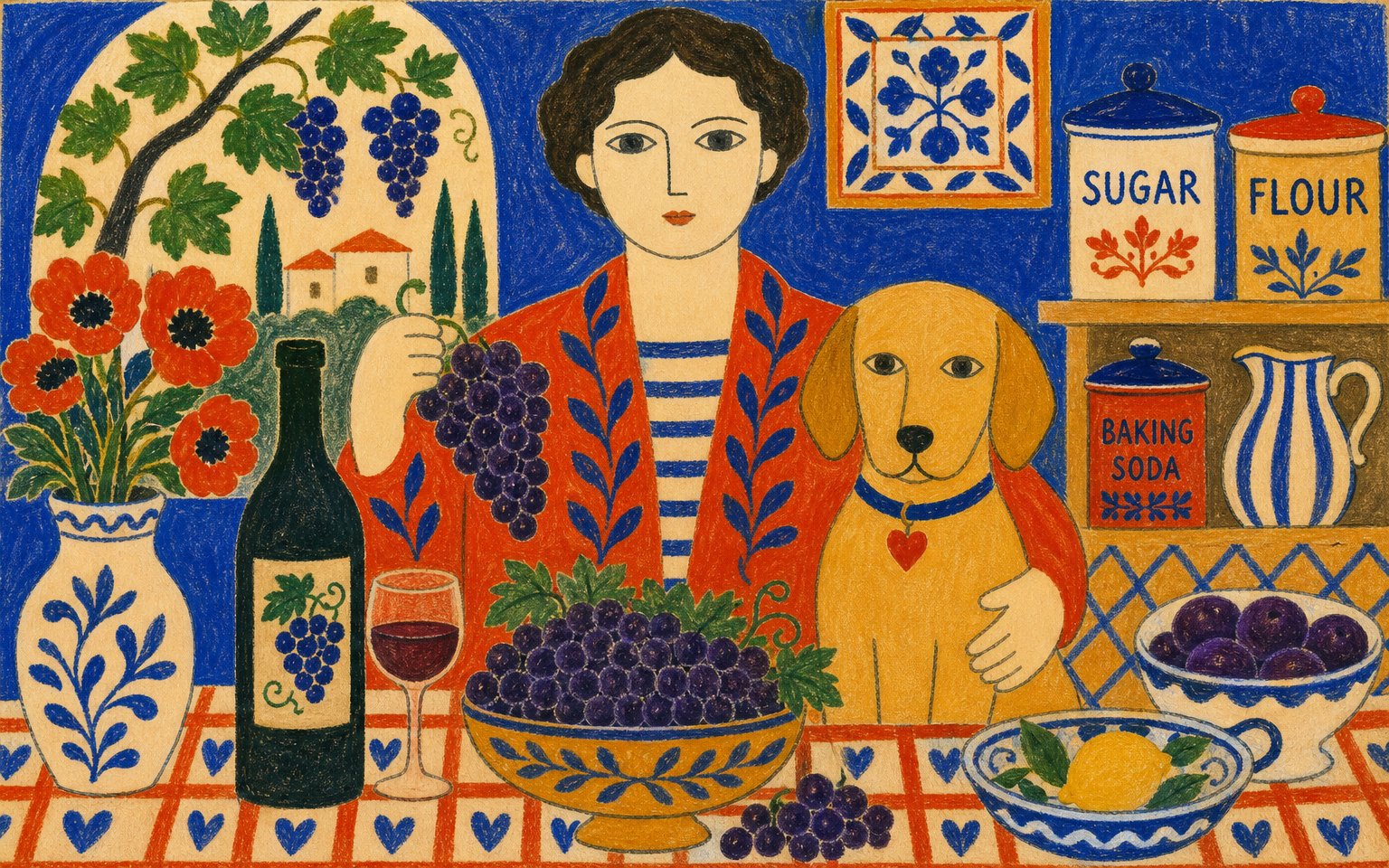
September is California Wine Month, and this year the fruit got there ahead of the calendar. Sparkling grapes in Santa Barbara came off the vine on June 30. Napa Valley Chardonnay started July 21. By early August, Texas Hill Country was in full swing, and Oregon's Willamette Valley was lining up for early-to-mid September. [1]
Which means a lot of dogs are about to spend a weekend somewhere with grapes on the ground.
It's a good moment to revisit the grape question, because the answer changed a few years ago and a lot of people never heard about it.
Twenty years of "we don't know why"
Veterinarians have known since the late 1990s that grapes and raisins can cause acute kidney injury in dogs. What nobody could explain was the inconsistency. One dog eats a handful of raisins and goes into kidney failure. Another eats a whole bunch of grapes off the counter and is fine. There was no reliable dose, no clear pattern, and no identified toxin. [2]
The break came from an unlikely direction. The ASPCA's Animal Poison Control Center had a case of a dog with acute kidney injury after eating homemade playdough — the kind made with cream of tartar. On necropsy, the kidney lesions looked like the lesions in grape and raisin cases. Researchers went back through the poison control database, pulled cases of dogs that had eaten cream of tartar or tamarind, and found the same picture: matching clinical signs, matching lab work, matching tissue damage. [2]
The common ingredient is tartaric acid, and its salt, potassium bitartrate. The findings were published in the Journal of Veterinary Emergency and Critical Care, roughly two decades after the first cases were written up. [2]
Why the dose never made sense
Tartaric acid makes up somewhere between 0.35% and 2% of a grape. [2]
That's close to a sixfold range, and it varies by grape variety, by growing conditions, and by ripeness. Two dogs of the same size can eat the same number of grapes and take in very different amounts of the compound that actually does the damage. That's most of the mystery, explained.
It also means there is still no published safe dose. Cornell's Riney Canine Health Center puts it plainly: the exact toxic amount isn't known, sensitivity varies between individual dogs, and any ingestion is worth treating as potentially serious. [3]
The list is longer than grapes
The practical consequence of the tartaric acid finding is that the danger list grew:
- Grapes, raisins, sultanas, currants — fresh, dried, and cooked into things
- Cream of tartar, which is concentrated potassium bitartrate [2]
- Tamarind and tamarind paste [2]
- Homemade playdough, which is usually cream of tartar plus flour and salt [2]
Store-bought playdough is a different recipe and a different problem — mostly salt. Homemade is the one that carries tartaric acid, and it tends to live in houses with small children, which are also houses where a dog is likely to be underfoot.
What it looks like, and how fast
Cornell's timeline: signs usually appear 6 to 24 hours after a dog eats something, and can get worse over the following one to three days. [3]
Early on it looks like ordinary stomach upset — vomiting first and most often, then diarrhea, loss of appetite, drooling, belly pain, lethargy, dehydration. What follows over the next couple of days is the part that matters more: increased thirst and urination, weakness, swelling in the limbs, tremors or seizures, and eventually a dog that stops producing urine. [3]
Treatment is inducing vomiting if the ingestion was recent and the dog still looks well, then hospitalization on IV fluids for at least two days with kidney values rechecked. Severe cases that don't respond may need hemodialysis at a specialty hospital. Dogs treated early, before kidney values climb, generally do well. Once a dog stops urinating, the outlook gets considerably worse. [3]
The window matters more than the amount here, which is why "wait and see if he seems okay" is the approach to skip.
Harvest season specifics
Most grape exposures aren't dramatic. They're a dropped snack, a guest handing something over, a low bowl on a coffee table. During harvest there are a few extra ones:
- Vineyard tours and grape stomps. Dog-friendly tasting rooms are common in wine country, and fruit ends up on the ground during crush.
- Picnic tables and cheese boards. Grapes are standard garnish, and they roll.
- Trail mix and granola bars. Raisins hide well in both, and dogs are efficient about them.
- Backyard vines. If you grow table grapes, the fruit under the trellis is worth clearing.
- Fall baking. Cream of tartar shows up in snickerdoodles, meringues, and homemade playdough season, which arrives with the school year.
If your dog eats any of it, call your veterinarian or the ASPCA Animal Poison Control Center right away, and be ready to say roughly what, roughly how much, and roughly when. Don't wait for symptoms — by the time a dog looks sick from tartaric acid, the useful window has mostly closed.
Sources
- "The 2026 U.S. grape harvest begins early, pointing to a smaller crop." Vinetur, August 7, 2026. https://www.vinetur.com/en/20260807105401/the-2026-us-grape-harvest-begins-early-pointing-to-a-smaller-crop.html
- "Toxic Component in Grapes and Raisins Identified." ASPCApro, on the findings published in the Journal of Veterinary Emergency and Critical Care. https://www.aspcapro.org/resource/toxic-component-grapes-and-raisins-identified
- "Grape and raisin toxicity." Cornell University College of Veterinary Medicine, Riney Canine Health Center. https://www.vet.cornell.edu/departments-centers-and-institutes/riney-canine-health-center/canine-health-information/grape-and-raisin-toxicity