
World Food Prices Hit a Near Four-Year High on Friday. Pet Food Is Up 1.3% — but One in Five Dog Owners Has Already Traded Down.
Pet food inflation is running below grocery inflation, but owners are trading down anyway. Doing it well comes down to one label statement, a seven-day schedule, and knowing that cats are on a much shorter clock than dogs.
The FAO Food Price Index came in at 133.3 points for August, published Friday — up 1.9% on July and 2.5% on a year ago, with all five commodity groups rising and sugar up nearly 12% in a single month [1]. Reuters put it as the highest reading since November 2022 [2]. (Worth noting the FAO itself doesn't frame it that way; it benchmarks against the March 2022 peak, which the current index still sits 16.8% below [1].)
Here's the part that complicates the obvious story. US pet food prices are not what's surging. In the latest CPI data, pet food and treats were up 1.3% year over year, against 2.7% for groceries and 3.4% for the headline index [3]. Retail pet food prices rose about 1.4% across the whole two years to May 2026, after climbing nearly 22% during 2021–23 [4]. The category is expensive in level; it is not currently expensive in rate. What's actually driving "petflation" is veterinary services, not the bag [5].
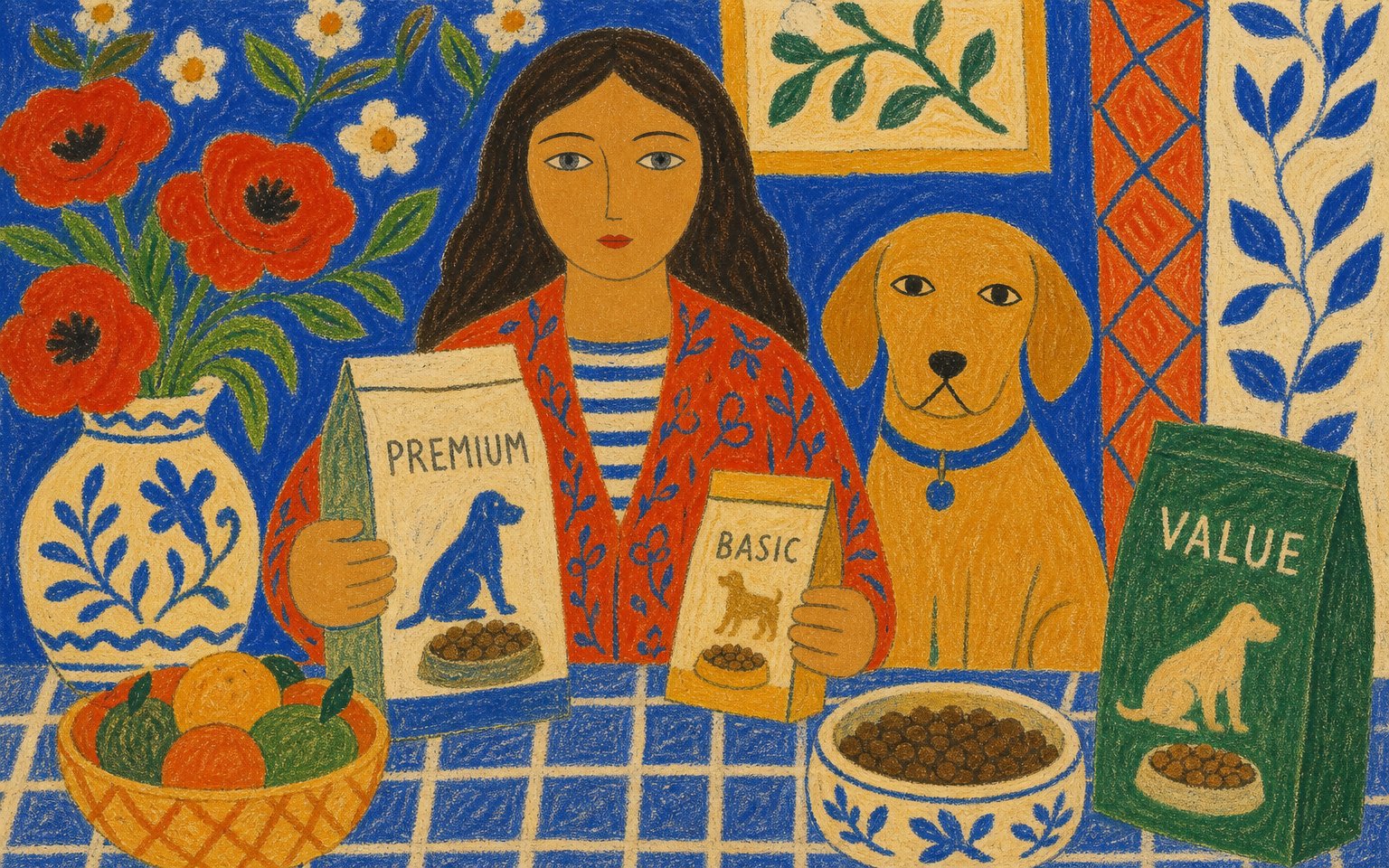
And yet people are trading down anyway, which makes sense — the pressure is on the whole household budget, not on one aisle of it. The American Pet Products Association's 2026 dog report found use of basic dog food up 11% year over year, to 21% of owners; supermarket purchasing up 7%, to 32%; and buying from discount retailers up 22%, to 22%. Premium is still the most-fed category at 31%, but owners are increasingly blending premium and budget products. Treat spending is down 11% [6].
Packaged Facts found that of owners who changed food in the previous year, about a third moved to a cheaper national or store brand, and that 47% now think private label is comparable in quality to national brands — up from 37% two years earlier [7]. Separately, 48% of US adults surveyed said they're paying more than they consider acceptable for pet food and supplies, and 27% planned to spend less [8].
So: how do you do this without a vet bill that cancels out the saving?
Check one line on the label
Every complete pet food carries an AAFCO nutritional adequacy statement, and it comes in one of three forms [9]:
- "[Product] is formulated to meet the nutritional levels established by the AAFCO Dog (or Cat) Food Nutrient Profiles for [life stage]."
- "Animal feeding tests using AAFCO procedures substantiate that [product] provides complete and balanced nutrition for [life stage]."
- "[Product] provides complete and balanced nutrition for [life stage] and is comparable to a product which has been substantiated using AAFCO feeding tests."
Version 2 is the stronger one. "Formulated to meet" means the recipe adds up on paper against a nutrient table. A feeding trial means the food was fed to actual animals and the nutrients turned out to be available to them. Tufts' veterinary nutrition service recommends feeding-trial diets as generally preferable, and says the distinction matters most for puppy and kitten foods and for newer or smaller companies with less formulation experience [10].
If a product instead says it is "intended for intermittent or supplementary feeding only," it isn't a complete diet and shouldn't be the whole bowl [9].
Two things worth knowing about labels right now. First, AAFCO's pet food label modernization is mid-rollout — a new Pet Nutrition Facts box, an intended-use statement on the front, standardised storage icons — approved in 2023 with a six-year transition, so you will see old-style and new-style labels side by side on the same shelf for the next few years [11]. Second, the long-standing memorandum of understanding between AAFCO and the FDA lapsed at the end of 2024, and new ingredient definitions now go through an FDA consultation process described as interim [12]. Neither changes what to look for. Both are reasons not to assume two labels are directly comparable.
WSAVA's guidance for evaluating a brand is short and answerable by a phone call or an email [13]:
- Do they employ a qualified nutritionist?
- Who formulates the diets?
- What is the quality control process, for both ingredients and finished product?
- What product research or nutrition studies have they done?
They also make a point worth keeping in mind while comparing two bags: the ingredient list tells you nothing about ingredient quality, and can be actively misleading about the overall quality of the food [13].
Compare cost per calorie, not cost per bag
The bag price is the wrong unit. A cheaper food with lower calorie density means more cups per meal, and the saving can evaporate.
Calorie content has been mandatory on US pet food labels since 2014, given as kilocalories per kilogram as fed and per familiar unit — per cup, per can, per biscuit [14]. Find that number, work out how many calories your pet actually needs per day, and calculate what a day of feeding costs. Tufts' worked example on two comparably premium foods came out at $704 a year versus $282 — a difference driven by calorie density and format rather than quality, since canned food is far more expensive per calorie than dry [15].
That comparison is also where a genuinely good saving often hides: switching format, or portion size, rather than switching brand.
Then switch slowly — slower than feels necessary
The American Animal Hospital Association's guidance is that a sudden switch may cause digestive upset and food aversion, especially in cats. Dogs should transition over seven days, starting by replacing about 25% of the old food, then increasing the proportion based on how your pet takes it. Cats may need up to 40 days [16].
The familiar 25/50/75 day-by-day grid you see on retailer sites is a reasonable practical schedule, but it isn't an official guideline — the sourced advice is seven days for dogs, start at a quarter, and go by acceptance.
There is controlled evidence behind this, if a small study. Thirteen beagle puppies were switched from a salmon-based to a poultry-based diet, seven abruptly and six over seven days. The abrupt group had significantly worse stool scores and higher rates of soft stool and diarrhea, and the gradual group ended up with more of two beneficial gut bacteria [17]. Small, single-breed, puppies — directional rather than definitive, but it points the same way as the clinical advice.
Cats are on a clock, and it is short
This is the part where a well-intentioned money-saving switch can turn into a serious problem.
A cat that stops eating for three to four consecutive days is at real risk of hepatic lipidosis — fatty liver — and the risk is higher if the cat was overweight to begin with [18]. Once jaundice appears the condition is fatal without rapid, aggressive treatment, and recovery usually means six to seven weeks of tube feeding [18]. Cats who develop it don't generally start eating again on their own [19].
Which is why the old advice to "just leave the new food down, they'll eat when they're hungry" is one to retire for cats. Cats form fixed food preferences and will refuse a novel food even when hungry, and pushing food on a cat who clearly doesn't want it risks creating a learned aversion to it [20]. The standard clinical threshold for stepping in is three to five days without food intake [20].
Practically: never withhold the old food to force acceptance, transition over weeks rather than days, and if your cat has eaten little or nothing for two days, call your vet rather than waiting to see whether day three fixes it.
One thing to be careful about while trading down
If you're moving away from a premium food, you may end up choosing between grain-free and grain-inclusive options, and the internet on this subject is a decade out of date in both directions.
Where things stand: the FDA's investigation into diet-associated dilated cardiomyopathy has never established causation, its last substantive update was December 2022, and it does not recommend avoiding grain-free diets [21]. Current veterinary cardiology work points at diets high in pulses — peas, lentils, chickpeas, beans — rather than at the absence of grain, and notes that this includes both grain-free and grain-inclusive foods, since both can be pulse-heavy. The specific mechanism of injury to the heart still hasn't been identified [22].
The practical translation: switching to a grain-inclusive food is not, on its own, a safeguard. Some budget grain-inclusive foods lean heavily on pulses. If pulses are near the top of the ingredient list, that's the thing to ask your vet about, whatever the front of the bag says about grain.
The short version
Pet food isn't where the current inflation is, but household budgets don't care where inflation is. If you're trading down, the moves that hold up are: check for a feeding-trial AAFCO statement, compare cost per calorie rather than per bag, transition over a week for a dog and over weeks for a cat, and never let a cat go days without eating in order to win the argument.
Sources
- FAO, FAO Food Price Index, released 4 September 2026. https://www.fao.org/worldfoodsituation/foodpricesindex/en/
- Reuters, World food prices hit highest since late 2022, 4 September 2026. https://ca.finance.yahoo.com/news/world-food-prices-highest-since-134336383.html
- US Bureau of Labor Statistics, Consumer Price Index, Table 2 (reference month July 2026). https://www.bls.gov/news.release/cpi.t02.htm
- PetfoodIndustry, Pet food: Comparing the CPI to the PPI, 8 July 2026. https://www.petfoodindustry.com/pet-food-market/news/15829531/pet-food-comparing-the-cpi-to-the-ppi
- PetfoodIndustry, Pet prices hit record highs as petflation grows to 4.3%. https://www.petfoodindustry.com/pet-food-market/news/15822535/pet-prices-hit-record-highs-as-petflation-grows-to-43
- American Pet Products Association, America's dog owners are becoming smarter spenders, 22 July 2026. https://americanpetproducts.org/news/americas-dog-owners-are-becoming-smarter-spenders
- Packaged Facts via PetfoodIndustry, Trading down may be sticky as pet owners seek value. https://www.petfoodindustry.com/pet-food-market/market-trends-and-reports/article/15773316/trading-down-may-be-sticky-as-pet-owners-seek-value
- L.E.K. Consulting via PetfoodIndustry, Survey: U.S. consumers report paying more for pet food amid tariffs. https://www.petfoodindustry.com/pet-food-market/market-trends-and-reports/news/15769367/survey-us-consumers-report-paying-more-for-pet-food-amid-tariffs
- AAFCO, Reading Labels. https://www.aafco.org/consumers/understanding-pet-food/reading-labels/
- Tufts Cummings School of Veterinary Medicine, Nutrition FAQs. https://vet.tufts.edu/foster-hospital-small-animals/specialty-services/nutrition/nutrition-faqs
- AAFCO, Pet Food Label Modernization. https://www.aafco.org/pflm/
- US FDA, Animal Food Ingredient Consultation (AFIC). https://www.fda.gov/animal-veterinary/animal-foods-feeds/animal-food-ingredient-consultation-afic
- WSAVA Global Nutrition Committee, Selecting a Pet Food for Your Pet (2021 update). https://wsava.org/wp-content/uploads/2021/04/Selecting-a-pet-food-for-your-pet-updated-2021_WSAVA-Global-Nutrition-Toolkit.pdf
- AAFCO, Calories. https://www.aafco.org/consumers/understanding-pet-food/calories/
- Tufts Petfoodology, Pet Food Cost Calculator. https://sites.tufts.edu/petfoodology/2019/06/10/pet-food-cost-calculator/
- American Animal Hospital Association, Nutrition tips and timelines for pet parents. https://www.aaha.org/wp-content/uploads/globalassets/05-pet-health-resources/nutritionalresources/petparent/aaha-tips-and-timelines.pdf
- Liao P. et al., "Abrupt Dietary Change and Gradual Dietary Transition Impact Diarrheal Symptoms, Fecal Fermentation Characteristics, Microbiota, and Metabolic Profile in Healthy Puppies," Animals 13(8):1300 (2023). https://www.mdpi.com/2076-2615/13/8/1300
- VCA Animal Hospitals, Liver Disease (Fatty Liver Syndrome) in Cats. https://vcahospitals.com/know-your-pet/liver-disease-fatty-liver-syndrome-in-cats
- University of Illinois College of Veterinary Medicine, Hepatic Lipidosis: When Cats Don't Eat. https://vetmed.illinois.edu/pet-health-columns/hepatic-lipidosis-when-cats-dont-eat/
- Michel K.E., "Management of Anorexia in the Cat," Journal of Feline Medicine and Surgery. https://pmc.ncbi.nlm.nih.gov/articles/PMC10822205/
- US FDA, Investigation into Potential Link between Certain Diets and Canine Dilated Cardiomyopathy. https://www.fda.gov/animal-veterinary/outbreaks-and-advisories/fda-investigation-potential-link-between-certain-diets-and-canine-dilated-cardiomyopathy
- Freeman L.M., Update on Diet-Associated Dilated Cardiomyopathy, Tufts Petfoodology, 22 June 2026. https://sites.tufts.edu/petfoodology/2026/06/22/update-on-diet-associated-dilated-cardiomyopathy-june-2026/