
It's National Pet Diabetes Month. The Two New Pills for Diabetic Cats Are Approved Only for Cats Who Have Never Had Insulin — and a Third of the Trial Cats Who Had Got Sick in Week One.
November is National Pet Diabetes Month, and feline diabetes care has changed more in the last four years than in the thirty before it. Two once-a-day pills now exist, AAHA rewrote its cat guidelines in 2026 — and the eligibility line on those pills is not fine print.
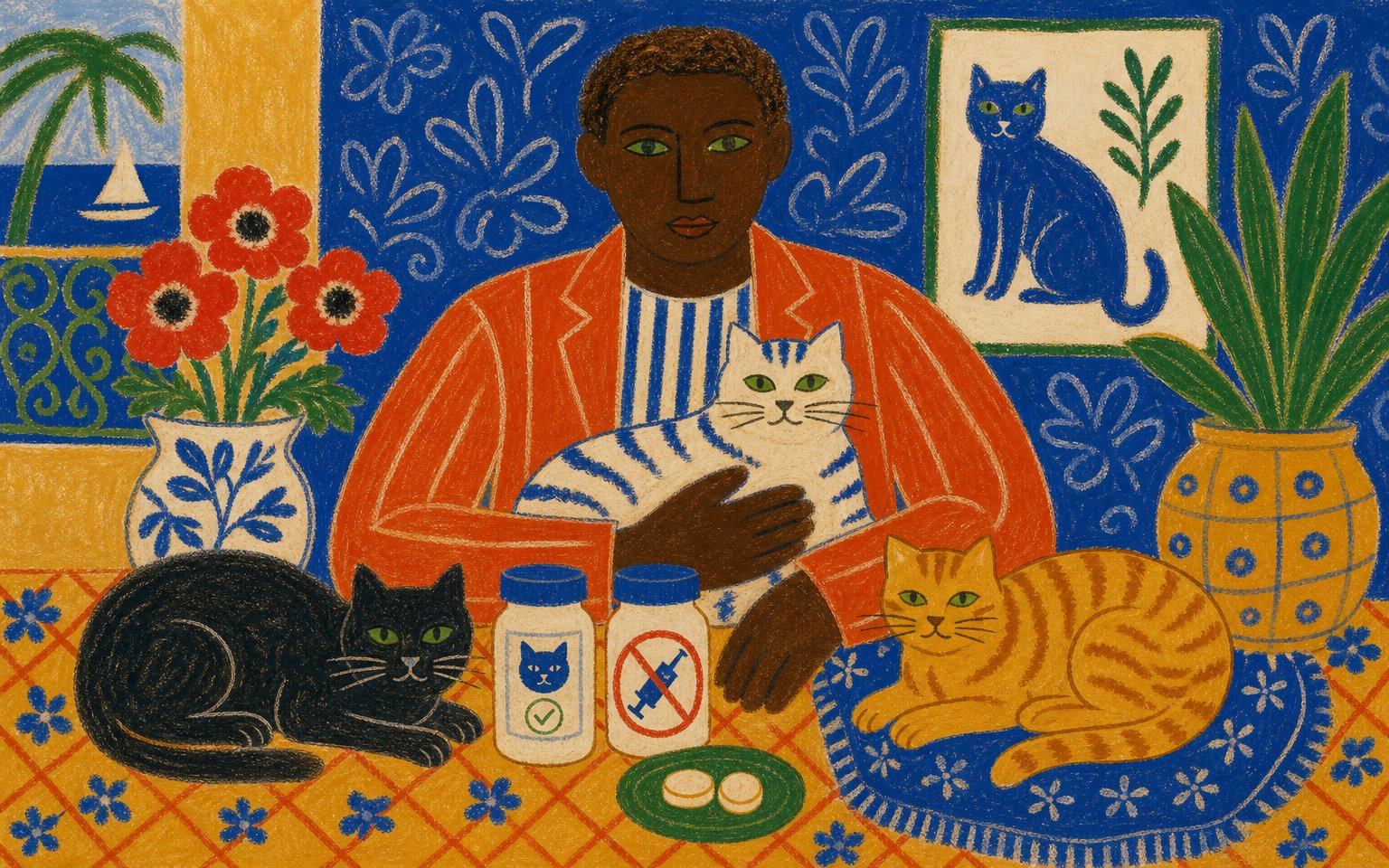
November is National Pet Diabetes Month, an awareness push the Diabetes PetCare Alliance has run since 2014. [1] It lands this year in the middle of the biggest shift in feline diabetes care in decades: two oral drugs that didn't exist four years ago, and a set of professional guidelines rewritten specifically for cats a few months ago.
Both changes come with a condition attached, and the condition is the part worth reading twice.
What changed in the guidelines
In May 2026, the American Animal Hospital Association released its 2026 Diabetes Management Guidelines for Cats — its first recommendations built around cats alone, rather than the combined dog-and-cat guidelines it published in 2018. [2] A canine version was scheduled to follow.
The most practical change for owners: routine in-hospital blood glucose curves are no longer recommended for diabetic cats. [2] The reason is stress hyperglycemia — a cat's blood sugar rises at the vet from the stress of being there, which distorts the readings the curve is supposed to produce. Monitoring now leans on clinical signs, continuous glucose monitoring, and glucose data collected at home. [2]
The guidelines also added recommendations on the new drug class, following FDA approvals of Bexacat in 2022 and Senvelgo in 2023, "for otherwise healthy cats with diabetes mellitus not previously treated with insulin." [2] Dr. Ingrid Taylor, AAHA's director of guidelines, framed them this way: "...they are good options for many cats, careful patient selection and monitoring are required." [2]
The two pills
Both are SGLT2 inhibitors — a drug class that works by making the kidneys dump excess glucose into the urine instead of returning it to the bloodstream.
Bexacat (bexagliflozin tablets, Elanco) was announced on December 9, 2022, as the first orally administered prescription medication to improve glycemic control in cats with diabetes, and the first SGLT2 inhibitor the FDA approved in any animal species. [3] It's given once daily. In the pivotal field study in newly diagnosed, otherwise healthy cats, 83% were considered a treatment success by day 56. [3]
Senvelgo (velagliflozin oral solution, Boehringer Ingelheim) was approved August 10, 2023, dosed at 1 mg/kg once daily, regardless of blood glucose level. [4] In its field study — 252 cats enrolled across more than 20 U.S. sites, 198 included in the effectiveness analysis — 175 cats (88.4%) were a treatment success at day 30. [4]
Those are good numbers. Now the other column.
Why "never treated with insulin" is more than paperwork
Both drugs are approved only for otherwise healthy cats not previously treated with insulin. [3][4] That reads like a formality on a label. It isn't.
In Senvelgo's field study, 38 of the enrolled cats had previously been treated with insulin. Twelve of them — 32% — developed ketonuria, diabetic ketoacidosis or euglycemic DKA within the first week, and those cases accounted for 46% of the removals from the study in that first week. [4] The FDA summary states that use in cats previously treated with insulin is contraindicated. [4]
Across the whole field study, including eligible cats, 18 cats (7.1%) developed DKA or euglycemic DKA, most within two weeks of starting; 14 (5.6%) developed ketonuria; and 13 (5.2%) passed away or were euthanized. [4]
Bexacat carries a boxed warning along the same lines. Elanco's safety information says not to use it in cats who have previously been treated with insulin, who are currently receiving insulin, or who have insulin-dependent diabetes, and warns of DKA and euglycemic DKA, "both of which may result in death." [3] It also advises against starting it in cats who are showing pancreatitis, anorexia, dehydration or lethargy at diagnosis, or who have liver disease or reduced kidney function. [3]
Euglycemic DKA is the awkward one. A cat can slide into ketoacidosis while its blood glucose reading looks fine, which means the number that usually reassures you may not be the number that matters more here.
Dr. Cynthia Ward of the University of Georgia has made the related point that not every cat qualifies, because a cat needs enough functioning beta cells for this class of drug to do anything. [5]
The remission picture
Cats are unusual among diabetic patients: many of them get better. With intensive management — home glucose monitoring, twice-daily insulin and a low-carbohydrate diet — roughly half or more of diabetic cats no longer need insulin injections within a few weeks to a few months of starting treatment, according to the Animal Medical Center. [6] Diabetes is probably the second most common hormone disorder in cats, after hyperthyroidism. [6]
That's a strong argument for catching it early, which brings this back to the part that's actually in your hands.
What to watch for at home
The early signs are easy to rationalize away, particularly in a cat who has always been a bit heavy:
- Drinking noticeably more, and refilling the water bowl more often than you used to.
- Urinating more — heavier clumps, a litter box that needs changing sooner.
- Losing weight while eating well, or eating more than usual.
- Walking down on the hocks rather than up on the toes, a flat-footed back-leg stance that points to diabetic nerve damage.
- A dull coat, lethargy, or vomiting, which tend to show up later.
A urine test and a blood test settle it quickly, and the cats who do best are generally the ones seen before the picture gets complicated.
One caveat on all of the above: this is a summary of published guidelines and FDA documents, not veterinary advice, and the choice between insulin and an oral drug depends on things only an exam and bloodwork can establish. If your cat is already on insulin, nothing here suggests switching — the trial data points firmly the other way.
Sources
- dvm360, National Pet Diabetes Month: Raising awareness and making strides, November 29, 2021. https://www.dvm360.com/view/national-pet-diabetes-month-raising-awareness-and-making-strides
- AVMA News, Updated AAHA diabetes management guidelines focuses on cats, May 19, 2026. https://www.avma.org/news/updated-aaha-diabetes-management-guidelines-focuses-cats
- Elanco, Elanco Announces FDA Approval of Bexacat (bexagliflozin tablets), December 9, 2022. https://www.elanco.com/en-us/news/elanco-announces-fda-approval-of-bexacat
- U.S. Food and Drug Administration, Freedom of Information Summary, NADA 141-568, Senvelgo (velagliflozin oral solution), approved August 10, 2023. https://animaldrugsatfda.fda.gov/adafda/app/search/public/document/downloadFoi/14320
- dvm360, Old vs new: Treatment options for cats with diabetes, November 3, 2023. https://www.dvm360.com/view/old-vs-new-treatment-options-for-diabetic-cats
- Animal Medical Center, Diabetes in Cats: New Treatments and the Path to Remission, November 27, 2024. https://www.amcny.org/blog/2024/11/27/diabetes-in-cats-new-treatments-and-the-path-to-remission/