
GLP-1 Drugs Are Coming for Pets. A Cat Implant Is in Trials, and the Human Version Is Already Sending Dogs to the ER.
A six-month GLP-1 implant for overweight cats is in a clinical trial now, with FDA approval targeted for 2027–2028. Here's the realistic timeline, why your own Ozempic pen is a hazard, and what moves the needle in the meantime.
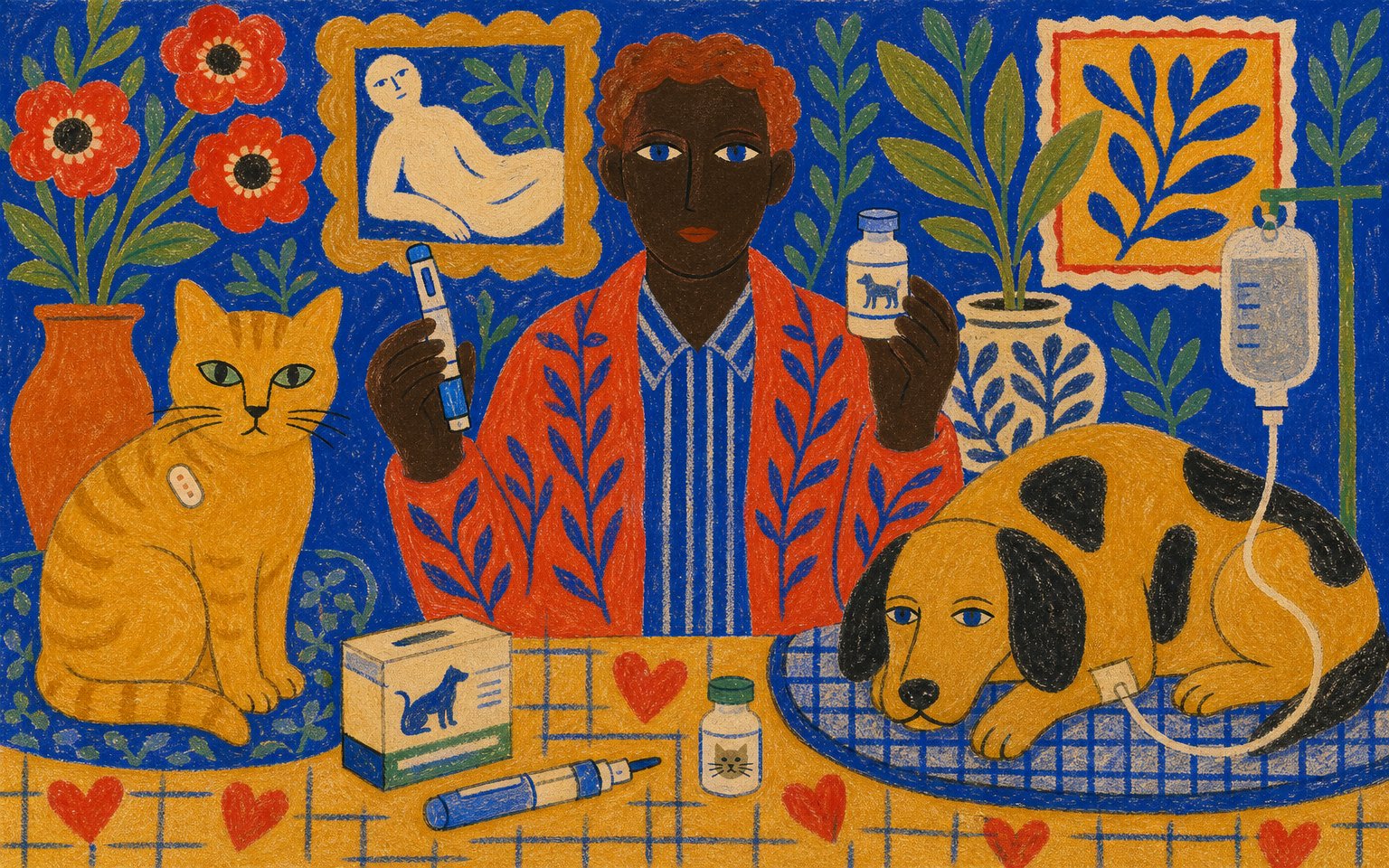
A San Francisco company called Okava Pharmaceuticals is running a trial named MEOW-1: roughly 50 cats, a miniature implant that releases the GLP-1 drug exenatide continuously for up to six months, with weight loss assessed at three months and monitoring through month six.[1] It's the first weight-loss trial of its kind in household pets. Okava is aiming to seek FDA approval between 2027 and 2028, at an anticipated cost around $100 a month, and plans to study the implant in dogs after the cat work.[1]
The Association for Pet Obesity Prevention expects pet weight-loss drugs to arrive within about five years, "based on the amount of interest and resources being deployed," and notes that Better Choice Company has acquired Aimia Pet Healthco to develop GLP-1 delivery as "treats and toppers."[2] The same piece is careful about what these drugs will and won't be: not "a panacea for sustaining healthy body composition," with "lifestyle modifications, physical activity, and diet" still doing much of the work.[2]
So: real, funded, and years out. Which leaves the question of what happens between now and then, because the weight is already on the pet.
Why the weight is worth treating at all
The clearest evidence in dogs comes from Purina's 14-year life span study. Forty-eight Labrador Retrievers, half of them fed 25% less than their littermates from puppyhood on. The lean-fed dogs' median life span was 1.8 years longer — a 15% extension, 13 years against 11.2.[3]
The joint numbers are just as striking. At age eight, osteoarthritis in multiple joints affected 77% of the control-fed dogs and 10% of the lean-fed ones.[3] By the end of the study, 83% of control-fed dogs had radiographic hip osteoarthritis, against 50% of the lean group.[3] Onset of chronic disease was delayed across the board.[3]
Cats get a similar argument from the company running the trial: "weight reduction is the only proven means of extending a cat's lifespan. Leaner cats have significantly reduced diabetes risk, and joint pain associated with excess body weight is eliminated."[1] More than half of household cats in the U.S. are overweight or clinically obese.[1]
"Feed less" has been the advice for decades
The survey data suggests it mostly hasn't worked, and not for lack of trying.
In APOP's 2025 Pet Obesity and Nutrition Survey, released this past March, only one in four dog owners said their pet reached and maintained a healthy body condition. For cats it was fewer than one in five.[4] Ninety-five percent of veterinary professionals recognize obesity as a disease, and 87% said concern about how clients would react shaped how they raised the subject.[4]
"Pet obesity is a disease, not a discipline issue," said APOP founder Dr. Ernie Ward. "When 4 out of 5 cat owners say they can't reach a healthy weight for their pet despite trying, the failure isn't theirs."[4]
One number from that survey stands out: only 16% of dog owners and 3% of cat owners weigh their pet's food. Nearly everyone else eyeballs it.[4] A scoop that's "about a cup" can be off by a third in either direction, every meal, every day.
Your own pen is not a shortcut
Human GLP-1 medication is not a stopgap while the veterinary version is in trials. Pet Poison Helpline has published cases that show how the exposures actually happen — and it's rarely someone deliberately dosing a pet.
A Siberian husky in Oregon was given multiple doses of Ozempic by a pet sitter who mistook it for insulin; the dog became lethargic and vomited, and spent two days hospitalized for hypoglycemia before recovering fully.[5] A cat named Mario got repeated Ozempic injections from a family member covering for the owner, and arrived at the emergency clinic severely hypoglycemic and dehydrated, needing dextrose, IV fluids and intensive care.[5] A wolf hybrid in New Mexico named Akila chewed a pen and swallowed the contents.[5]
"If you're not paying close attention, Ozempic can be easily confused with insulin," said Dr. Renee Schmid, senior veterinary toxicologist at Pet Poison Helpline.[5]
The ASPCA's Animal Poison Control Center reports vomiting, diarrhea, lethargy and decreased appetite as the most common signs after a GLP-1 exposure, with low blood sugar and pancreatitis possible but less likely.[6] Their line is (888) 426-4435.[6]
Three practical rules come out of those cases: store human medication where a curious dog can't reach it, keep human and pet injectables in physically separate places, and be specific with anyone covering for you about which pen is which.
What works between now and 2028
Weigh the food. A kitchen scale, once, gets you a gram number you can repeat. Of everything on this list, it may be the change most likely to shift the trajectory, and it costs about $15.
Ask about a therapeutic diet. Only 22% of dog owners and 35% of cat owners have used one.[4] They're formulated to keep nutrients adequate while calories come down — which plain "feed less of the usual food" does not do, since commercial diets are balanced to their calorie content.[7]
Go at the right speed. Tufts veterinary nutritionist Dr. Deborah Linder puts safe loss at 1–2% of body weight per week for dogs and 0.5–2% per week for cats — roughly 1 to 2 pounds a week for a 100-pound dog, about four ounces a week for a 20-pound cat.[7]
Take the cat number seriously. Cats who lose weight too fast can develop hepatic lipidosis, fatty liver disease, when fat is mobilized faster than the liver can process it. It can be fatal without treatment, and the early signs are behavior changes, lethargy and jaundice.[7] A cat who has stopped eating entirely is an urgent call, not a successful diet.
Count the treats. They're food. So are the crusts, the cheese the pill was hidden in, and the second dinner from the other person in the house.
The honest version of the timeline
If the trials read out well and the FDA agrees, an approved GLP-1 for cats could be available around 2027 or 2028, with dogs behind that.[1] That's an actual medication for an actual disease, and it may end up doing for pet obesity something like what these drugs have done in people.
It is also two or more years away, and it will land on top of measured food and a body condition score rather than replacing them.[2] The scale on the kitchen counter is available today.
Sources
- ABC News/GMA, "Weight loss drugs for cats? Company launches clinical trial of GLP-1 implants in cats," December 2, 2025. https://abcnews.com/GMA/Wellness/weight-loss-drugs-cats-company-launches-clinical-trial/story?id=128054236
- Association for Pet Obesity Prevention, "Pet Weight Loss Drugs Are Coming - Maybe Sooner Than You Think." https://www.petobesityprevention.org/articlesandnews/3wd6dsda1bpq1t4k7dgwsz2md3nm7p
- Purina Institute, "14-Year Life Span Study in Dogs." https://www.purinainstitute.com/science-of-nutrition/extending-healthy-life/life-span-study-in-dogs
- Association for Pet Obesity Prevention, "APOP 2025 Pet Obesity and Nutrition Survey Results Reveal Gaps in Weight Management for Dogs and Cats," March 22, 2026. https://www.petobesityprevention.org/articlesandnews/dzjvowbhdnq9ec6mkkmq9s39sim0ax
- Pet Poison Helpline, "Are Pets Being Poisoned with Ozempic?" https://www.petpoisonhelpline.com/toxintails/are-pets-being-poisoned-with-ozempic/
- ASPCA, "Pet Safety Alert: Rising GLP-1 Pet Exposures," March 5, 2026. https://www.aspca.org/news/pet-safety-alert-rising-glp-1-pet-exposures
- Deborah E. Linder, DVM, MS, DACVIM (Nutrition), "How Fast Is Too Fast For My Pet To Lose Weight?" Tufts Petfoodology, October 9, 2018. https://sites.tufts.edu/petfoodology/2018/10/09/how-fast-is-too-fast-for-my-pet-to-lose-weight/