
College Colors Day Is Today. A Dog Dyed Purple Needed Anesthesia Before Anyone Could See the Burns.
Team bandanas are easy. Dye is where it goes wrong — and human hair dye on a dog is a chemical burn waiting to happen, plus a second dose the dog swallows off her own coat.
Today is College Colors Day — the first Friday of the college school year, when the NCAA and its member schools ask everyone to wear their team's colors [1][2]. A lot of people will put the dog in it too: a bandana, a jersey, a collar in the right shade. That part is easy and it comes off at bedtime.
The part that sends animals to the emergency vet is dye.
Violet
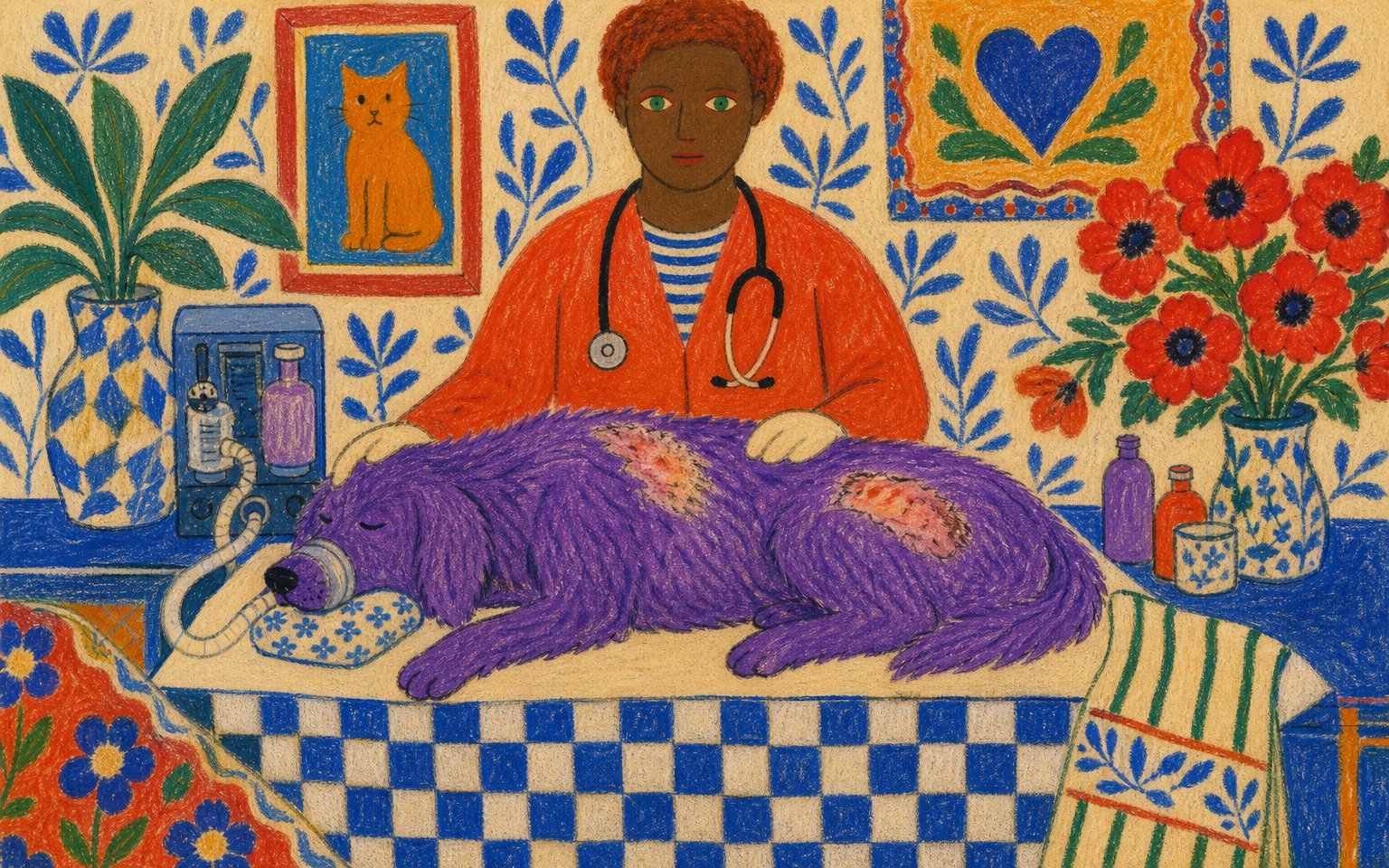
A five-pound white Maltese mix arrived at Pinellas County Animal Services in Florida after someone had colored her purple with human hair dye. Her eyes were swollen shut. She was listless. The damage to her skin was extensive enough that veterinarians had to put her under anesthesia just to assess it, and once the fur was shaved back, the burns underneath were open and painful. She needed fluids, pain medication, and chemical removal, followed by months of care. She recovered, and she was eventually adopted by a family that works in pet grooming and beautification. [3]
Animal Services summed it up plainly: human hair dyes are toxic and can cause both internal and external injuries to pets. [3]
There are two exposures, not one
The burn is the obvious one. Permanent color is built to force open the hair cuticle and develop pigment inside it — a process that assumes human scalp, a measured amount, and a rinse on a timer. A dog is a different surface at a different dose over a much larger share of the body, and the eyes are right there in the middle of it.
The second exposure is quieter, and it's the one that catches people who were careful about the first. Anything you put on a coat, the animal eats. They groom, they lick, they chew a paw. Preventive Vet documents a dog who developed hemolytic anemia — the destruction of her own red blood cells — after ingesting a henna-containing dye marketed as "all-natural." She recovered with treatment, but "natural" did not mean inert. [4]
Cats sit at the bad end of both. Their skin is more sensitive, they groom far more thoroughly than dogs do, and their metabolism handles a number of compounds differently. Even pet-formulated color lines tend to restrict cats to semi-permanent products and color shampoos rather than anything permanent. [4]
What professional groomers actually use
Groomers who do color work use products formulated for animals — semi-permanent dyes, color shampoos, chalks, paint pens, airbrushing — from brands built for that purpose, such as Opawz and Crazy Liberty. Some professionals have used human brands, but the consistent advice is to stay with products made for pets [4].
A few things worth knowing before the weekend:
- Patch test first, on a small area, and wait. An allergic reaction on one square inch is a much better outcome than one across a whole dog.
- Skip the DIY food-coloring recipes. Beyond the coat, sugary residue draws insects and other animals to your pet [4].
- Don't push a stressed animal through it. If she's fighting the process, the version where she also gets a face full of product is close behind.
- Nothing near the eyes, ears, nose, or genitals, which is most of what makes a "team logo on the side" idea go sideways.
The version that can't burn anything
If the goal is that the dog is visibly on your side this weekend, the fabric route gets you all of it: a team bandana, a jersey, a collar and leash set, a ribbon on the harness. It photographs the same, it comes off when she's had enough of it, and there is no metabolism involved.
If something is already on her
Get it off — a thorough wash with a gentle pet shampoo, repeated — and then watch for redness, swelling, scratching or rubbing at a spot, head shaking, squinting or a weepy eye, lethargy, vomiting, or pale gums. Any of those, or any dye that reached the eyes, is a call to your vet or an emergency clinic rather than a wait-and-see. The ASPCA Animal Poison Control Center runs 24 hours at (888) 426-4435.
Wear the colors. Let the dog wear cotton.