
Colorado Has Logged Twice as Many Bear Reports as Last Year. Dogs Are in More Than Half of the Incidents.
Drought and a poor natural food year have pushed bears into neighborhoods at a record pace, right as they start eating 20 hours a day. The research on dogs and bears is blunt, and most of it plays out in backyards.
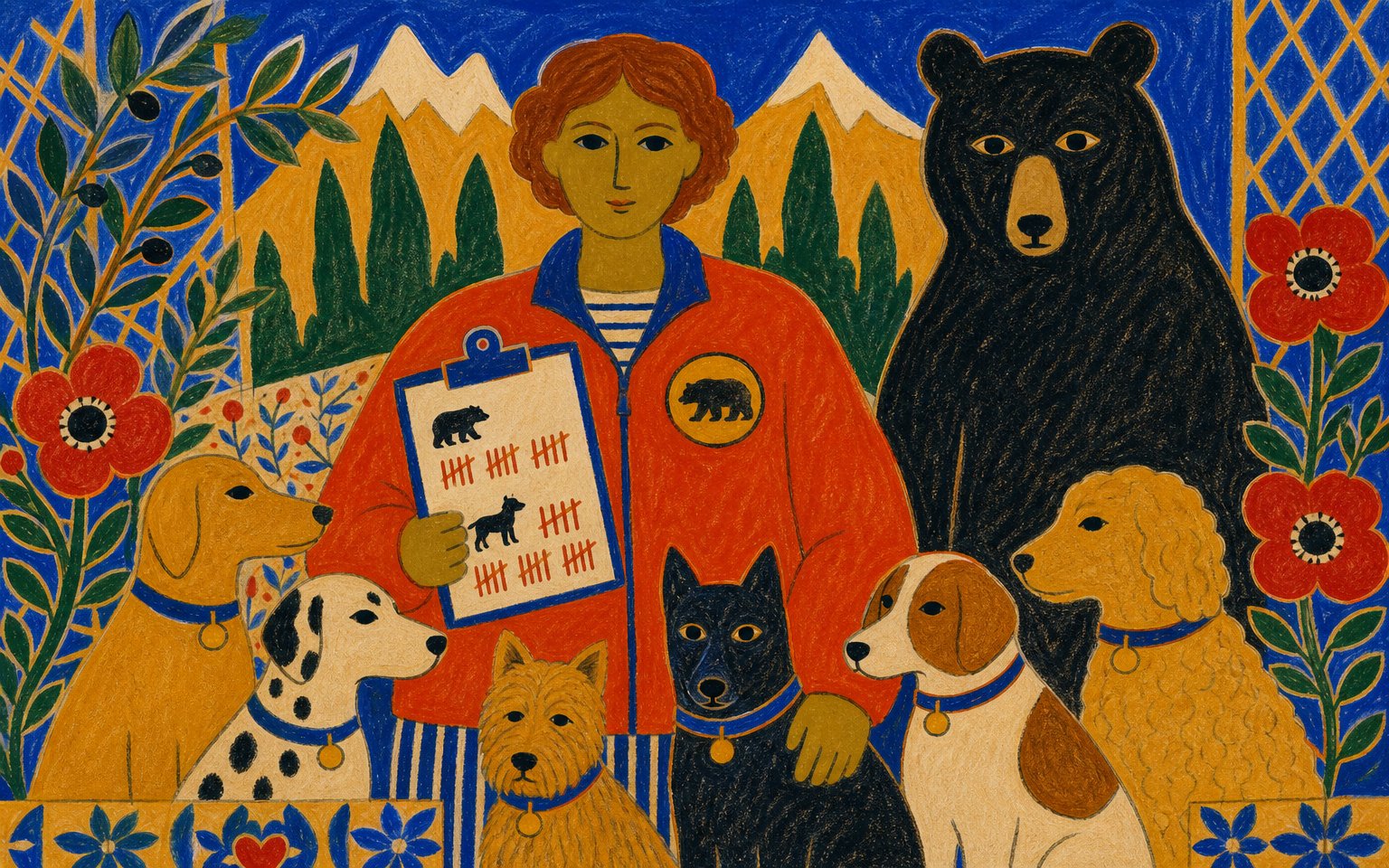
Colorado Parks and Wildlife logged 6,129 bear reports between January 1 and August 13 of this year. Over the same stretch in 2025, the number was 3,115 — and the 2026 total has already passed the 5,299 reports the state recorded across all of last year. It's the highest pace since CPW's digital reporting system launched in 2019.[1]
The reason is food, or the lack of it. Low mountain snowpack, wildfires, and drought have thinned out the berries, acorns, and grasses bears would normally be eating right now.[1] Idaho Fish and Game has been reporting the same pattern this month, with black bears moving through the Wood River Valley in search of food.[2]
The timing is the hard part. Late summer and fall is hyperphagia — the stretch where bears spend as much as 20 hours a day eating to build the fat they need to get through winter.[1] A bear that can't find enough calories on the mountain in August will look for them where people are, and the food in a neighborhood is easier than the food in a meadow.
The research on dogs and bears is not subtle
If you have a dog, this is the part to know.
BearWise, the bear-education program run by state wildlife agencies, reports that dogs were involved in more than half of the black bear incidents with people recorded between 2010 and 2015. In those incidents, 46% of the dogs were injured or killed, and 62% of the owners were injured.[3]
A study in The Journal of Wildlife Management by Tom Smith of Brigham Young University and Stephen Herrero found much the same thing. Dogs initiated more than half — 54% — of the 326 human-bear conflicts analyzed. Dogs were injured or killed in roughly two-thirds of encounters. In the 8.3% of cases where a dog flushed a bear back toward its owner, the owner was injured 70% of the time. Having a dog along more than doubled a group's risk of a negative bear encounter.[4]
The mechanism is easy to picture. A dog barks, lunges, or gives chase; the bear reads that as a threat and responds defensively; the dog, losing the argument, runs back to the person it trusts most, with the bear behind it.[3] Bears can outrun dogs, and both of them are faster than you.
The study found one thing that reliably helped: not a single person carrying bear spray was injured, dog or no dog.[4]
Two caveats worth keeping in mind. The dogs in these studies are mostly off-leash dogs, and the conflicts are mostly on trails and in yards, not deep wilderness. This is a neighborhood and day-hike problem more than an expedition problem.
Most of it happens in the yard
The stereotype is a trail encounter. The common version is a dog let out the back door at 10 p.m. into a yard that already has a bear in it.
What actually reduces that, drawn from CPW's guidance and BearWise:[1][3]
- Feed pets indoors, and bring the bowls in. An outdoor bowl left on a porch is a reliable draw. CPW's phrasing: "Never leave pet food outdoors."[1]
- Secure garbage and recycling, take bird feeders down while bears are active, and clean the grill after every use and store it.[1] The grill grease trap is the one people forget.
- Look before you let the dog out. A porch light, thirty seconds at the door, and some noise from you before the dog goes through it.[3]
- Motion-activated lights in the yard help for the same reason.[3]
- Secure pet doors. Bears can get through openings as small as nine inches.[3]
- Don't let a dog bark at a bear through a fence. A fence that stops the dog does not stop the bear, and it converts a passing animal into a defensive one.[3]
On walks
BearWise's advice is a non-retractable leash, kept on, in bear country — at home and on trails.[3] In a place with an active bear season, a fifteen-foot retractable line is roughly the same as having no leash at the moment it matters. Bear spray, carried where you can reach it in a couple of seconds rather than zipped in a pack, is the other piece.[4]
Dawn and dusk are the higher-risk hours. Noise on blind corners — talking, not a bear bell — gives a bear the chance to leave before you get there.
If it happens anyway
The instinct is to go get your dog. Every bear-safety program says the same thing about that: don't.[3] Physically intervening between a dog and a bear is how owners end up in the injury statistics.
Instead: use bear spray from a safe distance, or a high-pressure garden hose if you're at home and one is right there.[3] Call the dog rather than chasing it. If the bear notices you and hasn't approached, back away slowly, keeping it in view. If it comes toward you, stand your ground, wave your arms, and make noise — CPW suggests yelling "Hey bear."[1] Give the animal a clear escape route; a bear that feels cornered against a fence or a garage has fewer options than one that can leave.
Afterward, report the encounter to your state wildlife agency. Reports are how agencies find the block with the unsecured dumpster that's keeping a bear in the neighborhood.
Cats and small dogs
Black bears are not primarily a predation risk to pets — the conflicts above are mostly defensive. But a small dog in a yard at night, in a year when bears are hungry and moving through town, is in a different situation than a 70-pound dog on a leash in daylight. Supervised trips outside after dark, cats kept in overnight, and the food and trash measures above are the practical answer, and they're the same measures that keep the bear out of trouble.
That last part matters more than it sounds. A bear that finds food in a neighborhood comes back to that neighborhood, and a bear that keeps coming back usually ends up dead. The yard checklist protects the dog and the bear at the same time.
If you're nowhere near Colorado
Range states from the Sierras to Appalachia see the same seasonal push, and drought years amplify it. Your state wildlife agency's website will have current activity notes and a reporting line, and BearWise's guidance is written to apply across all of them.[3] The measures don't change much: food in, trash secured, leash on, lights on, and a look outside before the dog goes out.
Sources
- KRDO, "Colorado sees record pace of bear reports amid drought and food shortages," August 14, 2026. https://krdo.com/news/wildlife/2026/08/14/colorado-sees-record-pace-of-bear-reports-amid-drought-and-food-shortages/
- Idaho Fish and Game, "Black bears continue to move through the Wood River Valley in search of food." https://idfg.idaho.gov/article/black-bears-continue-move-through-wood-river-valley-search-food
- BearWise, "Dogs and Bears = Trouble." https://bearwise.org/bear-safety-tips/dogs-and-bears/
- The Wildlife Society, "JWM: Dogs can do more harm than good in bear country" (Smith and Herrero, The Journal of Wildlife Management). https://wildlife.org/jwm-dogs-can-do-more-harm-than-good-in-bear-country/